

There is a tremendous patience in Henri Rousseau (b. 1844), on view as part of a major exhibition at the Barnes Foundation in Philadelphia. His Rendezvous in the Forest (1889) meticulously reproduces dense woodland foliage, a constellation of leaves blanketing the surface of the canvas and nearly concealing the illicit couple at its center. This is the work of an artist who knew how to bide his time, an artist whose primary profession was waiting Rousseau served as a customs agent at a toll gate in Paris for over two decades, the source of his nickname, Le Douanier Rousseau.
Yet Rousseau’s work is hardly observational a reminder that staring at the same view every day may mean we see less, rather than more, of it. Instead, he pursued an imaginative practice often characterized as “naïve,” though “Henri Rousseau: A Painter’s Secrets” dispels such illusions. The show is a collaboration between the Barnes and the Musée de l’Orangerie in Paris, and includes work from the collection of the Parisian dealer Paul Guillaume. Guillaume sold Albert Barnes many of his Rousseaus, making the exhibition a reunion of paintings that once passed through the same hands. Additional loans include MoMA’s enigmatic Sleeping Gypsy (1897), and taken together, the nearly 60 works reveal Rousseau to be a canny entrepreneur who played to shifting market forces.

Rousseau may have been self taught, but he had a copyist’s pass to the Louvre, the source of many 19th-century artists’ educations. He was attentive to current events and incorporated them into his work. The Representatives of Foreign Powers Coming to Greet the Republic as A Sign of Peace (1907) later purchased by Picasso was a republican allegory in honor of the second Hague conference held in 1907. Rousseau combined representations of foreign leaders who had attended the conference with the French figure of Marianne and with a monument to the humanist thinker Étienne Dolet, all set against a city draped in flags, resulting in a complex collage of signs and symbols that show him to be anything but unaware of his surroundings. His surreal Football Players (1908) was a response to an impressive French performance in a match against England that year. Taking the growing interest in the sport as a point of departure, Rousseau’s players seem to dance, appearing both of the moment and suspended entirely outside of it.

What Rousseau did best was recast elements from his cultural milieu in his own personal idiom, which featured a flattened pictorial space, deliberate plays of scale, and an arch, almost caricatural stiffness to his figures. Fellow artists recognized the unique contribution of his style. The academic painter Jean Léon Gérôme reportedly advised Rousseau to preserve his naivety, which he increasingly wielded as a strategy. When caught committing bank fraud in 1907, the defense brought one of his paintings into the courtroom, which proved he was far too “naive” to knowingly participate in a crime (never mind that it was his second offense, having previously embezzled from a lawyer he worked for in 1863).
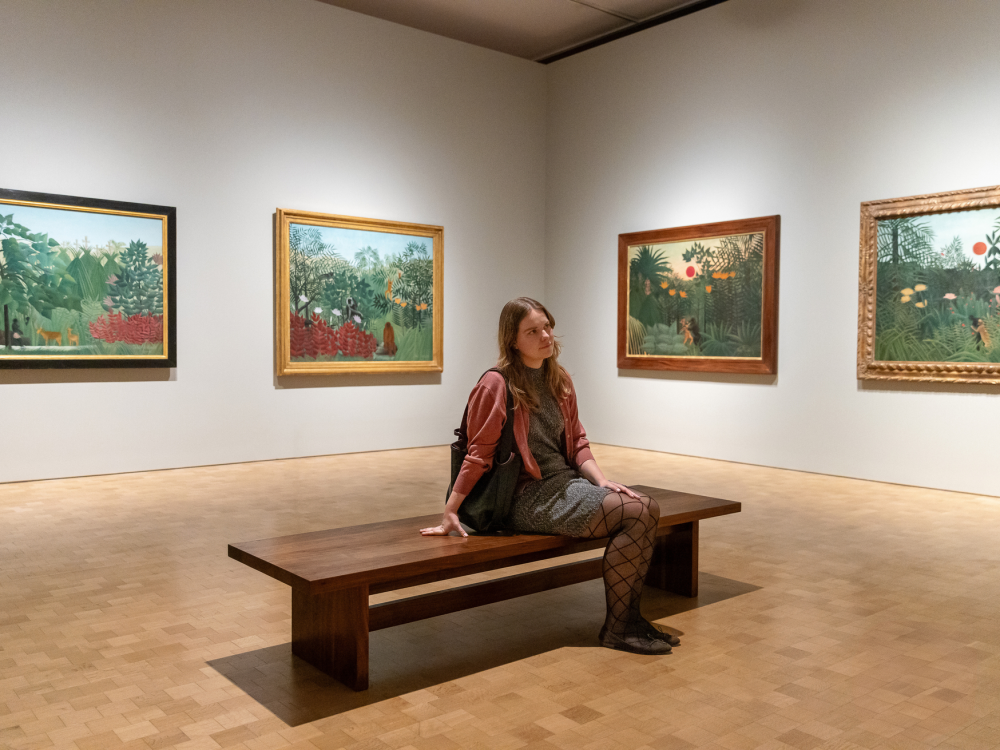
Rousseau needed the money after retiring from his customs duties in 1893. He wanted to make it as an artist, and the works that ultimately offered the greatest path to success were his jungle scenes. The exhibition features a full room of these large canvases, with tigers, monkeys, and gorillas romping amongst palm fronds and banana trees. He borrowed views of tropical landscapes from popular magazines and copied animals from illustrated books and taxidermy specimens at natural history museums; he was able to study exotic foliage at Paris’s botanical gardens, where plants brought from France’s overseas colonies thrived in greenhouses. In his haste to meet demand, the pictures lose the meticulousness of the early works, trading delicate details for sweeping motifs. Here too, Rousseau’s perceived innocence has provided an alibi, seemingly exonerating him from the racism of his times even as his art reproduced faceless Black figures locked into combat with jungle creatures in unspecified geographies. Despite Rousseau having never left France, these paintings created a vision of the tropics that fed an increasingly curious colonial imagination. Yet Rousseau’s painterly style brought a pictorial ambiguity to the clichéd sources he drew on, imbuing them with a luminosity and strangeness that still fascinates viewers today.

While Rousseau made little profit from his art he was constantly in debt to his colorman, one reason the later works were painted with such economy interest in his work took off after his death in 1910. As part of a postwar art market boom, Rousseau’s prices soared in the 1920s, with paintings selling for more than ten times what they had in his lifetime. Given growing inflation and a looming financial crisis, art provided an alternative investment opportunity, as it does today. Rousseau’s singularity, combined with an inability for viewers (and buyers) to securely fix his place within a history of art, may have made his art a perfect vehicle for speculation. For those like Albert Barnes who were willing to gamble, amassing what is still the largest collection of Rousseau canvases, the work continues to reward.
