

Montreal-based artist Adamo Macri has developed a multidisciplinary practice that moves between sculpture, photography, painting, video, and drawing. Across these different mediums, his work investigates questions of identity, transformation, contamination, and the delicate relationship between human existence and the natural world. Rather than treating an artwork as a fixed visual statement, Macri approaches each creation as an evolving occurrence, one that carries its own narrative and invites viewers to reconsider the boundaries between the artist, the artwork, and the surrounding world.
A defining characteristic of his practice is the use of his own physical presence as an artistic material. His body becomes a surface for transformation, a means of constructing images, and a vehicle through which complex stories can be communicated. This approach gives his work an intimate yet symbolic quality, allowing personal identity to intersect with mythology, cultural memory, and broader philosophical concerns. Each project contributes to an expanding anthology of visual narratives, reflecting an ongoing exploration of what it means to change, disappear, and assume another form.
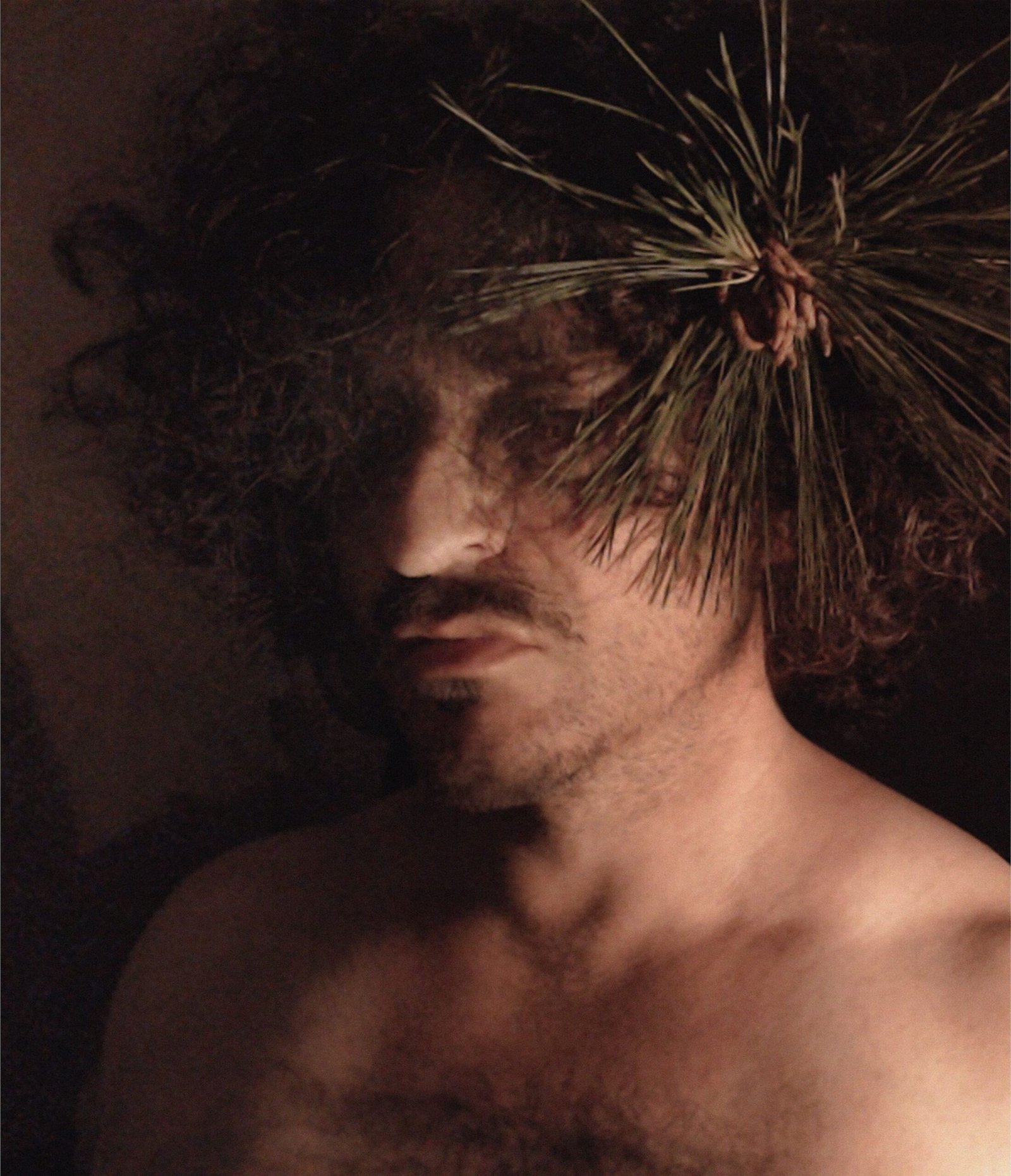
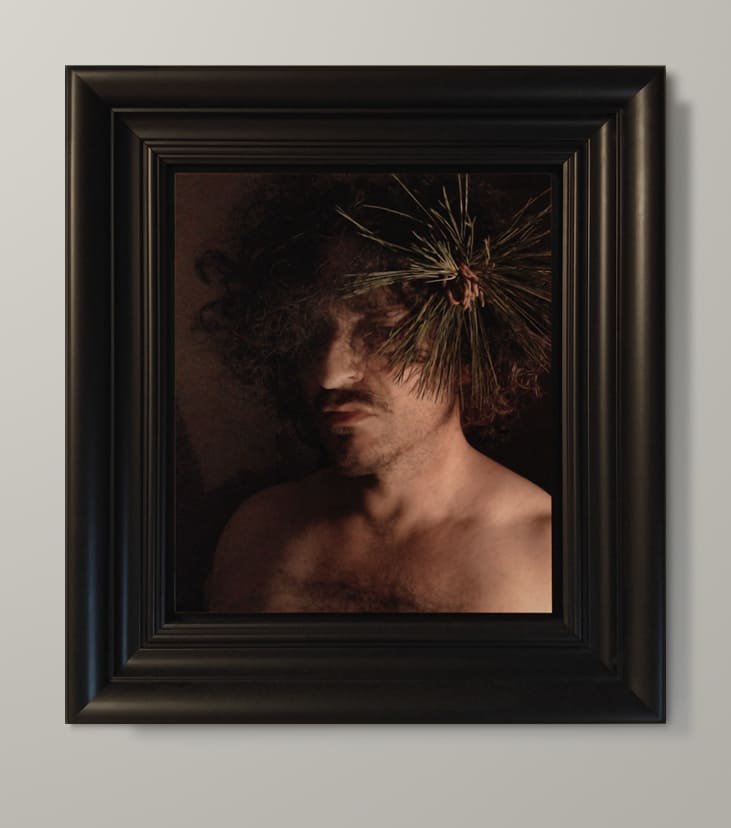
In Pinus Attis (2013), Macri brings many of these concerns together through a compelling photographic composition. Drawing upon ancient mythology and the symbolic significance of the pine tree, the work considers the relationship between sacrifice and renewal, bodily identity and spiritual transformation. What initially appears as a restrained, almost devotional image gradually reveals a more complicated meditation on the human condition and the enduring power of myth.
The Myth of Attis and the Sacred Pine
At the conceptual center of Pinus Attis is the ancient myth of Attis, a vegetation deity associated with the Great Mother Cybele. According to the mythological tradition, Attis becomes the victim of a tragic sequence involving divine jealousy, madness, and self-castration. In a moment of overwhelming distress, he mutilates himself beneath a pine tree and dies from his wounds. Cybele, unable to restore him completely, preserves his body in a transformed state. His hair continues to grow, and a finger remains in motion, suggesting a form of existence suspended between death and life.
Attis eventually becomes associated with the pine, an evergreen tree that embodies persistence and the recurring rhythms of nature. His transformation does not represent a straightforward return to his former human condition. Instead, he survives through another form of being, one that is simultaneously botanical, sacred, and permanently marked by loss.
Macri draws upon this mythology to construct the idea of the human being as a tree. In Pinus Attis, the transformation is more than a poetic comparison between humanity and nature. It becomes an unsettling proposition about the cost of becoming something different. The human body, traditionally understood as the foundation of individual identity, is reimagined through the symbolism of an organism that continues to exist beyond the boundaries of human life.
The pine consequently functions as both a symbol of endurance and a reminder of sacrifice. Its evergreen character suggests continuity, yet the myth behind it reveals that such continuity is achieved through profound physical and psychological rupture.
Self-Portraiture Beyond Physical Resemblance
Macri’s engagement with the myth of Attis also introduces a distinctive approach to self-portraiture. Rather than relying on recognizable facial features or conventional representations of the artist, he explores the possibility of expressing identity through symbolic transformation.
This interpretation connects with the discussion of Macri’s self-portraiture in Kenneth Radu’s essay, Behold the Man: Self-Portraits of Albrecht Dürer & Adamo Macri. The comparison with Albrecht Dürer offers an interesting perspective on the different ways artists have used their own images to examine questions of identity and authority. While Dürer’s self-portraits frequently establish a recognizable human presence, Macri approaches the self through displacement and metamorphosis.
In Pinus Attis, the artist’s body becomes inseparable from the mythological figure and its botanical counterpart. The resulting image suggests a self-portrait that does not necessarily depend on literal likeness. Instead, identity emerges through the symbolic language of transformation, sacrifice, and survival.
This approach is consistent with Macri’s wider artistic interest in using his physical presence as a medium. His body becomes a site upon which cultural narratives and personal reflections can converge. The transformation into a tree therefore carries an autobiographical dimension, suggesting the artist’s willingness to move beyond familiar representations of the self in pursuit of a more complex visual identity.
Pagan Mythology and the Christian Narrative
Another significant dimension of Pinus Attis lies in its relationship to religious symbolism. The myth of Attis has frequently been discussed in connection with broader traditions of death, resurrection, and seasonal renewal. Its associations with springtime rituals and the cyclical return of vegetation invite comparisons with Christian narratives surrounding the crucifixion and resurrection of Jesus.
Macri’s work engages this historical and symbolic territory without reducing the relationship between these traditions to a simple equivalence. The two narratives share recognizable themes of death and renewed existence, but their implications remain different. In the myth of Attis, transformation does not restore the individual to an entirely intact human condition. His continued existence is partial, suspended, and inseparable from the natural world.
This distinction is particularly important to the interpretation of the photograph. Rather than presenting resurrection as an uncomplicated victory over death, Pinus Attis considers a more ambiguous form of permanence. The transformed figure survives, but survival comes with an irreversible alteration of identity.
The pine becomes a meeting point between ancient vegetation rituals and later religious traditions. It carries the memory of sacrifice while offering an image of continuity. Through this symbolism, Macri encourages viewers to consider how religious narratives evolve, overlap, and acquire new meanings across different cultural periods.
The Body as Offering and the Symbolism of Renewal
The relationship between sacrifice and fertility gives the work another layer of significance. Within the myth of Attis, castration is both an act of destruction and the beginning of an alternative existence. The loss of physical wholeness becomes inseparable from the possibility of transformation.
Macri approaches this contradiction with particular sensitivity to the vulnerability of the body. The human form is not simply celebrated as an expression of individual identity; it becomes something that can be altered, reinterpreted, and absorbed into a larger symbolic system. Transformation offers the possibility of continuity, but it also demands the surrender of something fundamental.
The pine’s evergreen character intensifies this tension. Its enduring foliage represents life beyond seasonal decay, yet the mythology attached to it suggests that permanence is never entirely free from loss. The tree becomes a monument to an existence that continues under altered conditions.
Even the association of pine with scent contributes to the mythology’s sensory dimension. Unlike a visual image, fragrance is temporary and difficult to preserve. It enters the surrounding environment, connecting memory with physical experience. The pine therefore represents not only an object of remembrance but also a sensory trace of the sacred rituals associated with Attis.
Between Living Organism and Sacred Effigy
One of the most compelling aspects of Pinus Attis is its refusal to settle into a single interpretation. The pine can be understood as Attis himself, a representation of the artist, or an effigy commemorating an absent body. It occupies a space between living organism and symbolic object, presence and disappearance, natural growth and cultural construction.
This ambiguity reflects Macri’s broader interest in images that reveal and conceal at the same time. His work frequently examines how visual representations can carry meanings that extend beyond their immediate appearance. In this photograph, the seemingly familiar image of a tree becomes charged with questions about bodily integrity, mortality, religious memory, and the desire for permanence.
The work also challenges the assumption that transformation necessarily produces a more complete or perfected identity. Attis does not return as he was. His survival depends upon becoming something fundamentally different. In this sense, the photograph proposes that identity may be understood not as a fixed condition but as an ongoing process shaped by loss, adaptation, and the passage of time.
The Enduring Significance of Pinus Attis
Created in 2013, Pinus Attis demonstrates Adamo Macri’s ability to bring mythology, self-representation, and conceptual inquiry into a concentrated photographic work. Measuring 16 x 19 inches (41 x 48 cm), the photograph uses the symbolic potential of its subject to explore questions that extend far beyond its immediate visual form.
Its significance lies in the tension between beauty and disturbance, continuity and rupture, and the human desire to transcend the limitations of the body. By revisiting the myth of Attis, Macri presents transformation not as an uncomplicated liberation but as an experience that carries both possibility and consequence.
Ultimately, Pinus Attis leaves viewers with an image of survival that is neither entirely human nor entirely removed from the natural world. The sacred pine becomes a living monument to sacrifice, preserving the memory of a body that has undergone an irreversible change. Through this powerful intersection of ancient mythology and contemporary self-portraiture, Macri creates a work that invites reflection on the fragile boundaries of identity and the many forms through which life, memory, and artistic expression continue to endure.
Discover More About Adamo Macri
Explore more of Adamo Macri’s artistic practice, projects, and creative journey through his official website and social media channels.
- Website: adamomacri.blogspot.com
- Facebook: facebook.com/Adamo.Macri
- YouTube: youtube.com/user/adamomacri
