

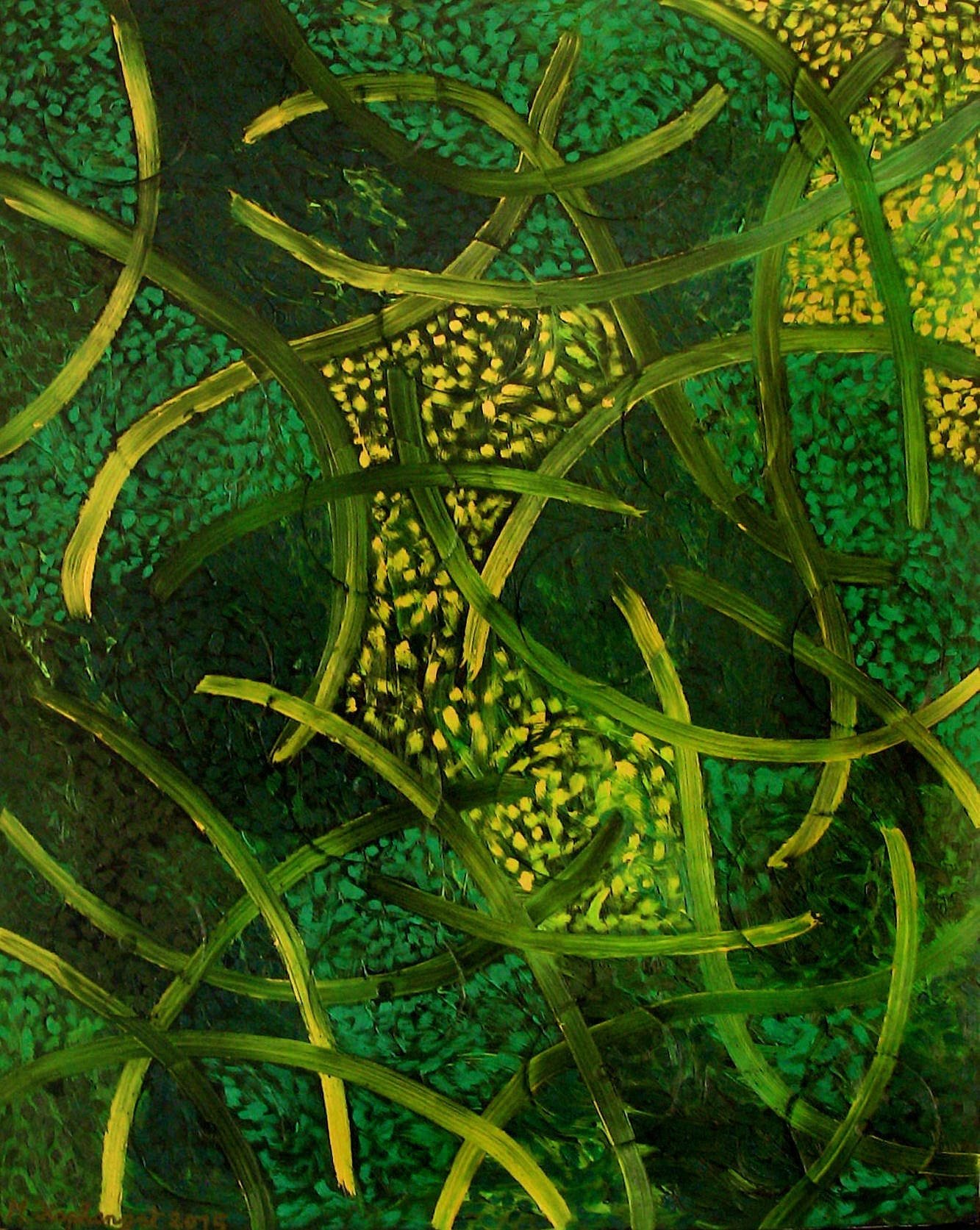
Michael Kaphengst was born in 1969 in Norden, a small town on Germany’s flat northern coast, where the horizon stretches wide and the North Sea sets the rhythm of daily life. He was the youngest of three children, with two older sisters a decade ahead of him. His father was never part of the picture, and his mother, overwhelmed by the demands of raising three children alone, placed him in a children’s home while he was still an infant. Those early years remain hazy in his memory. He returned home around the age of nine or ten, but his mother’s recurring hospital stays meant that absence and instability continued to define much of his childhood.
A Body Trained for Discipline
Faced with an unsettled home life, Kaphengst turned to physical activity as a source of order. He played soccer and tennis, trained in karate to the level of a blue belt, and built a home gym around dumbbells and a weight bench. Sport gave him something his early years had not: structure, discipline, and a sense of control over his own body. He still plays badminton and lifts weights today, a habit that has followed him from adolescence into adulthood. In time, art would offer him a parallel form of refuge, one built not around physical strength but around visual expression.
Discovering Dalí and a Language of Objects
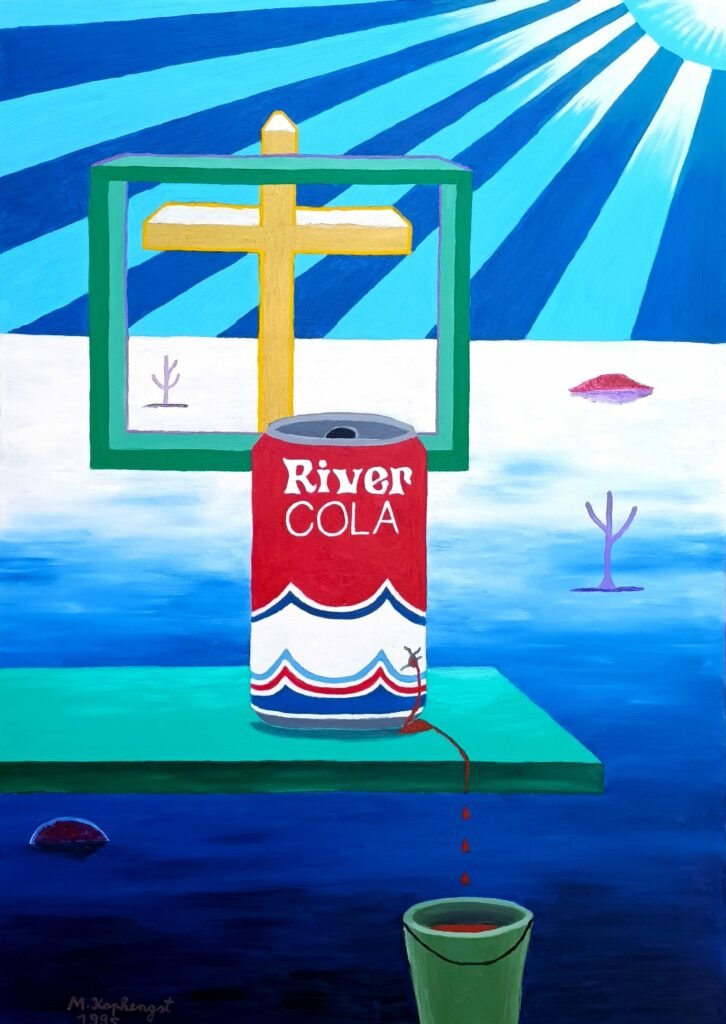
Kaphengst’s entry into art came through Salvador Dalí and Surrealism, and specifically through their fascination with dreams, fantasy, and the unconscious mind. He began reading widely, attending drawing classes with local artists, and painting on his own. Gradually, he developed a visual vocabulary centered on consumer products and everyday objects, which he rendered in surreal, unsettling compositions. While living on a street in Berumbur called Linienwalk literally “Line Way” he started organizing his own exhibitions, designing posters, contacting the press, and promoting his work without institutional support. The street’s name would later feel like a quiet, almost accidental omen of the direction his art was headed.
Training as a Designer and the Birth of Consumptive Surrealism
In 1993, Kaphengst began formal training as a graphic designer in Minden and opened his own studio. His parallel study of modern art history, combined with a growing interest in Pop Art, led him toward a concept he would come to call Consumptive Surrealism: familiar consumer goods placed into strange, disorienting contexts that unsettle the viewer’s relationship to the ordinary. During this same period, a casual moment in a student residence empty cigarette packs being tossed around by fellow students sparked another thread of his work, as he began to see discarded packaging as raw sculptural material, a way of examining consumption and waste through the objects people throw away without thinking.
Linearism and the Line as Building Block
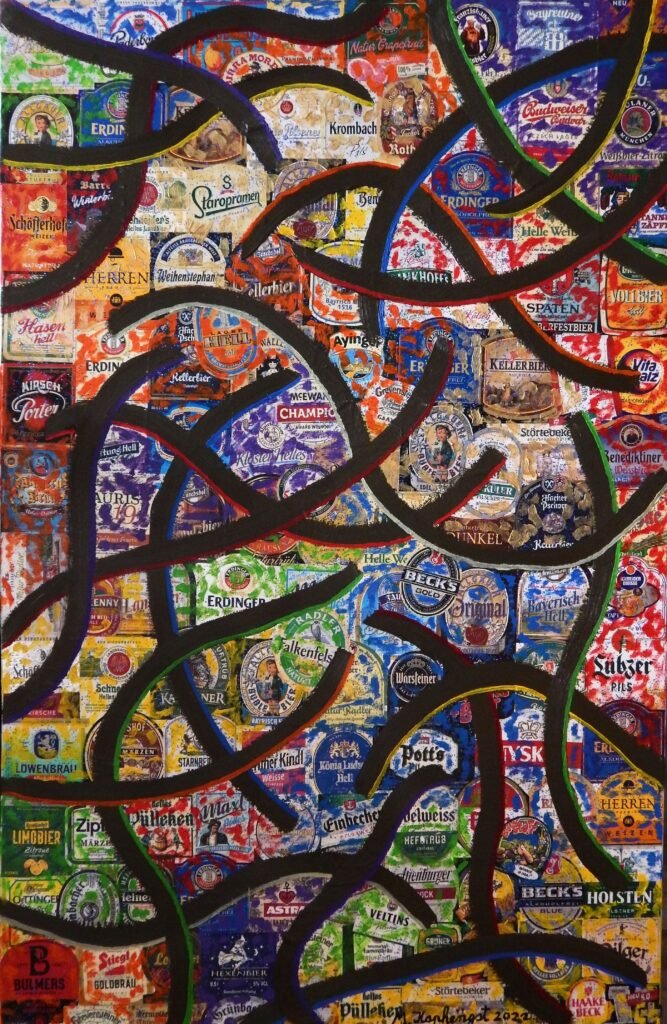
By 1995, Kaphengst had formalized a new method he called Linearism, in which an image is broken down into colored lines rather than built from solid forms or outlines. Instead of using a line to define the edge of a shape, he treated it as the fundamental unit of the image itself. This idea would become the backbone of much of his later work, resurfacing in different, increasingly physical forms over the following decades.
Theater, Studios, and Discarded Tape
After his design training, Kaphengst interned in set design at the City Theatre Wilhelmshaven and took a small role in the production of Der Schimmelreiter. He then moved to Hannover to train as a media designer for image and sound, taking on an acting workshop alongside his studies. Money was tight, and he sometimes gathered discarded materials from the street on trash collection days, looking for objects that could be repurposed into art. A move to Hamburg brought an internship at Studio Hamburg, where he worked behind the scenes on film and television productions. There, he encountered colored adhesive tape used to mark actors’ positions on set. Rather than seeing it as a purely functional tool, he began treating it as an artistic material a line, a trace, a sign and used it to build collages that fused the world of film production with his own evolving practice.
From the Stage to the Reeperbahn
Kaphengst’s acting workshop in Hamburg led him to pursue performance more seriously, and between 2005 and 2008 he completed formal training, earning an acting diploma. He worked in independent theater productions and spent six years as part of Blinde Passagiere, an ensemble of blind and sighted performers, where he acted, taught, and helped build stages and organize shows. Independent theater rarely paid enough to live on, so he worked as a bartender on Hamburg’s Reeperbahn to cover rent and health insurance. The job immersed him in the district’s crowded nightlife and its constant churn of routine, desire, and repetition observations that would later feed directly into his art.
Fencing, Movement, and Extreme Linearism
During his acting training, Kaphengst became skilled at fencing, and inspired in part by Niki de Saint Phalle’s shooting paintings, he began experimenting with attaching a paintbrush to the tip of a fencing foil, letting the physical act of fencing generate lines across the canvas. This experiment became Fencing Pictures – Absolute Linearism in 2009, merging martial discipline, bodily movement, and painting into a single gesture. His years on the Reeperbahn continued to shape his thinking about consumption, leading him to a broader idea: that escaping the linear process of daily life its routines of work, leisure, and consumption, is impossible. In 2012, this thinking crystallized into Extreme Linearism, a method built on intense, physically driven drawing, in which a pencil moves across paper in circular, seemingly uncontrolled motions until an image emerges purely from line and repetition.
A Quieter Life, A Continuing Practice
After roughly fifteen years in Hamburg, the pressures of city life and the difficulty of sustaining a career in both acting and art left Kaphengst exhausted. Before leaving, he completed Train-the-Trainer education and qualified as an instructor for continuing and adult education. He then moved to the countryside to be with his girlfriend, working first as a tiler including installing bathrooms in private homes and on luxury cruise ships at Meyer Werft and later obtaining a bus driving license to work as a public transit driver. Throughout these career shifts, he kept making art. Today, his work has reached audiences well beyond Germany, shown in galleries and institutions across Europe and internationally, a body of work shaped as much by fencing foils and adhesive tape as by paint and canvas.
Discover more of Michael Kaphengst’s artistic journey, latest works, and creative experiments on Instagram: Michael Kaphengst on Instagram
