

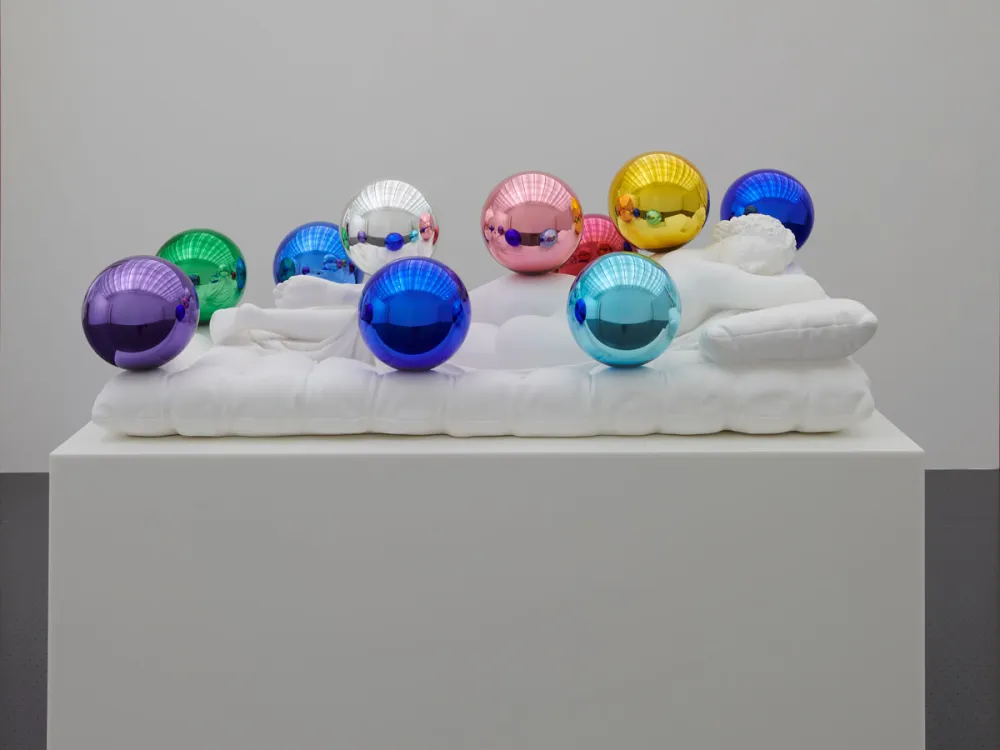
Just over a year ago, some 100 high-profile contemporary artists from Jeff Koons and Paul McCarthy to Julie Mehretu and Camille Henrot to Claire Tabouret and Julien Creuzet were invited to copy masterpieces from the Louvre’s collection. Their imitations now form the basis of “Copyists” at the Centre Pompidou-Metz, a satellite of the Pompidou in northeastern France. “It’s an exhibition by copyists more than a presentation of copies per se,” cocurator Donatien Grau, said at a press preview in June.
Among the imitated works are Eugene Delacroix’s Liberty Leading the People (1830), Giovanni Bellini’s Portrait of a Man (ca. 1475–1500), Théodore Géricault’s The Raft of Medusa (1818–19), and Thomas Gainsborough’s Conversation in a Park (1746–48). Some of these new copies were complete shortly before the show opened, arriving just days before the preview. This contemporaneous relationship with artistic heritage has opened up new ways of viewing centuries old art, according to Grau, who is head of contemporary programs at the Louvre.
“This reinterpretation of history is not at odds with innovation; on the contrary, it fuels it,” he said. “The exhibition is like a metaverse brought into the real world a physical project, featuring physical works, displayed in a physical space. Each piece created for this exhibition is in dialogue with artists from all times.”
The first room serves as a manifesto of sorts, featuring artists from various generations and with different practices. Koons’s contribution faces off with one by octogenarian Japanese artist Takesada Matsutani. Both have copied Bernini’s Sleeping Hermaphrodite (1619); Koons via sculpture and Matsutani in painting. “The Western perspective, literal and reverent, is counterbalanced by a more conceptual approach” by Matsutani, Centre Pompidou-Metz director and exhibition cocurator Chiara Parisi told ARTnews.

While most of the artists are represented by one copy, Giulia Andreani had trouble choosing just one masterpiece. So, she is presenting three works in “Copyists”: one based on Vermeer’s The Lacemaker (c. 1669–1670); another after an undated female head, attributed to the school of Leonardo da Vinci; and a third after Marie Guillemine Benoist’s Portrait of Madeleine (1800), whose model was only identified in 2019. For Andreani, the primary focus for her mostly faithful copies was a technical one. “Acrylic, which is not a noble material, is absent from the Louvre using this technique over oil is a statement in itself,” she said of her rendition of Portrait of Madeleine. For her version of The Lacemaker, Andreani has sized up the painting from 9.6 by 8.3 inches to 63 by 55 inches and translated it into watercolor.

Beginning in the Renaissance, copying masterpieces was a core of artists’ training, though that began to wane in the late 19th century. While copying is still part of some art school training, like it was for Andreani, who studied at the School of Fine Arts in Venice, Yan Pei-Ming, who graduated from the École Nationale Supérieure des Beaux Arts in Dijon in 1986, said he wishes he had received this education.
“Today, that practice has become rare; making a faithful copy of a painting is almost a lost art,” he said. A section of Rembrandt’s Bathsheba at Her Bath Holding King David’s Letter (1654) captivated Pei Ming’s attention for this project. “I was struck by the anonymous servant in the shadows, a figure without a name,” he said of his contribution to “Copyists,” which is almost a faithful reproduction, measuring to the exact dimensions of his excerpt from the painting, but with one key change: “rather than a color replica, I painted in dark grey.”

Other artists in the exhibition chose to reinterpret the original works. Xinyi Cheng’s painting Symphony of Chance, for example, references Georges de La Tour’s The Card Sharp with the Ace of Diamonds (ca. 1636–38). Long fascinated by the theme of card players in art, the Paris based Cheng came across it during one of her frequent visits to the Louvre, struck by its composition of three seated characters and one standing figure. She partially re-enacted the tableau in her studio, having some sitters pose in person, while others sent pictures of themselves playing cards.
“To copy per se feels impossible to do. I tried to keep the original in the back of my mind, to make room for myself,” Cheng told ARTnews. “In de Latour’s painting, the exchange of gazes gives away who the cheater is. I tried not to be as obvious, namely by blurring the eyes.”

Like Manet’s Olympia (1863) responding to Titian’s Venus of Urbino (1534), some of the artists have made key adjustments to the composition. In her transposition of Anne Louis Girodet’s Sleep of Endymion (1791), Los Angeles based artist Ariana Papademetropoulos has replaced the work’s two male figures—the namesake shepherd, who was also the lover of moon goddess Selene, and Zephyr, the god of the west wind with a floating pink crescent moon, moving Selene to the foreground and “inviting the viewer to daydream,” she said. In the original work, the goddess is represented only as a beam of moonlight.
French artist Paul Mignard drew inspiration from an Egyptian shroud, dated to 50–150 CE, in which a recently deceased figure meets Anubis and Osiris, the gods of death and the afterlife, respectively. Mignard’s diptych, Retroaction, includes a portrait of the artist by Anne Laure Sacriste, done in the style of the Fayoum region, where ancient Roman and Egyptian cultures interacted. Here, Mignard has inserted himself into the work.

But visitors may not be able to spot the differences in these compositions as the museum has chosen not to include reproductions of the copied masterpieces in the wall text, opting to just include their titles and dates. The curators were “aiming to avoid any layer of meta commentary,” said Parisi. “The exhibition was designed to embrace the unexpected a deliberately agile approach.”

In the spirit of contributing something unexcepted, Thomas Levy-Lasne brought his commissioned painting into the 21st century. Instead of just presenting a copy of Ingres’s Portrait of Monsieur Bertin (1832), his Chiraz and Bertin presents a mise en scène featuring a young woman facing the Ingres painting, to which the French artist has added the Louvre’s CCTV camera and wall text. Here, copying is more than a stylistic exercise, it’s both a tribute to Ingres and a reflection on the contemporary gaze. “It’s the anti-Mona Lisa,” Levy Layne said. “We don’t really know what the French writer and art collector Bertin is looking at, nor if the visitor is truly gazing at him. They don’t seem to connect.”
He continued, “I was more interested in portraying the painting as an object in its everyday context. Ingres designed the frame after the one made for Raphael’s Portrait of Balthasar Castiglione another painting from the Louvre which points to Ingres’s desire to become part of history.”
