

James Day works across more disciplines than most artists attempt in a lifetime, and the interest of his practice lies less in any single medium than in how they speak to each other. Painting, photography, sculpture and diorama making have all passed through his hands over twenty-five years, and each has left its mark on the others.
A Practice Without Fixed Borders
What distinguishes Day’s work is not a signature style so much as a signature sensibility, one that treats the flat canvas and the built scene as two ends of the same project. His early paintings, made in bright, saturated colour, have given way over the decades to a photorealistic technique paired with a distinctly personal form of surrealism. More recently, since 2020, that same sensibility has pushed outward into three-dimensional space, first through figurative sculpture and now through diorama making.
Stillness and Refreshment
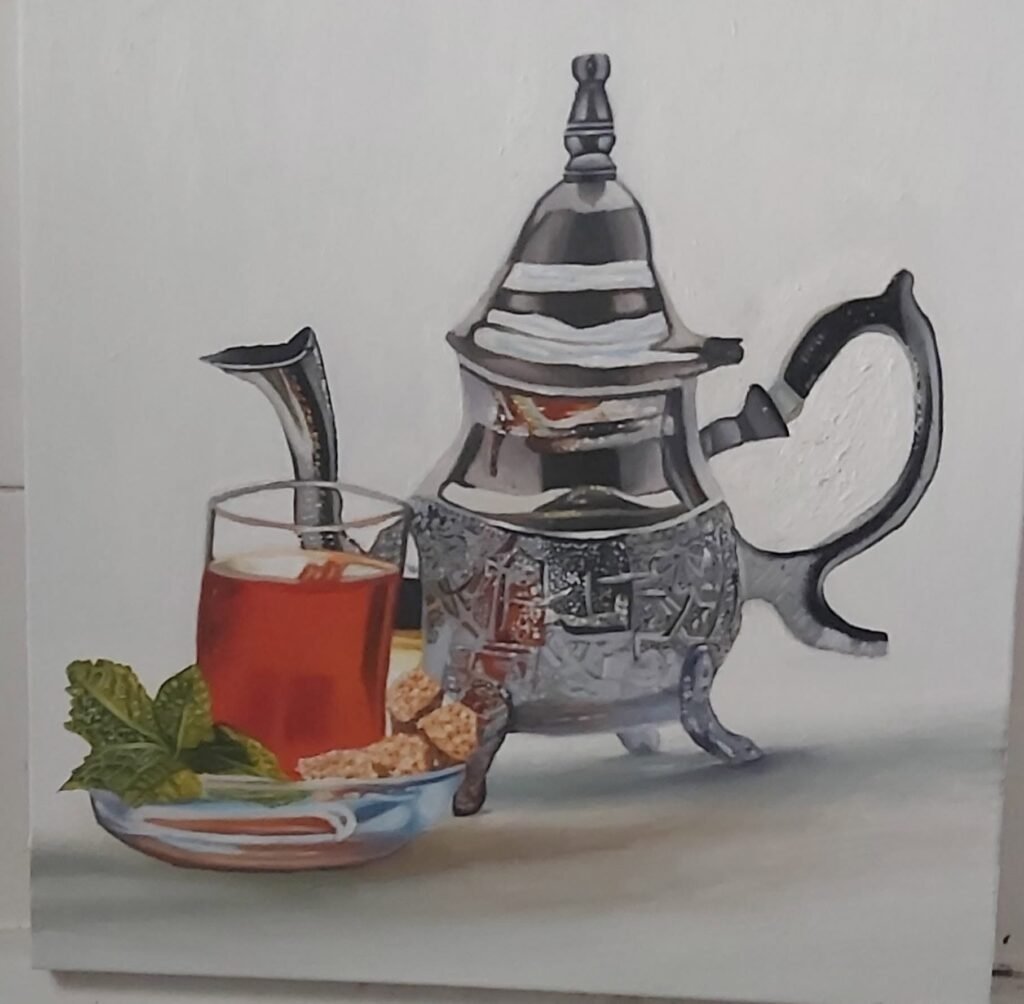
I Like Mint Tea sits comfortably at the more contemplative end of Day’s practice. A still life of a glass of mint tea beside an ornate Islamic teapot, it grows out of an interest in Islamic visual culture that Day has carried since the very start of his career, when he made bright drawings of Islamic architecture in the 2000s and later cartoons through the 2010s. What makes the painting notable is its intent: Day wanted the image itself to feel refreshing, as though its precision could stand in for the sensation of the drink it depicts. It is a modest ambition, and the painting achieves it without overstatement.
Humour and the Unexpected Pairing
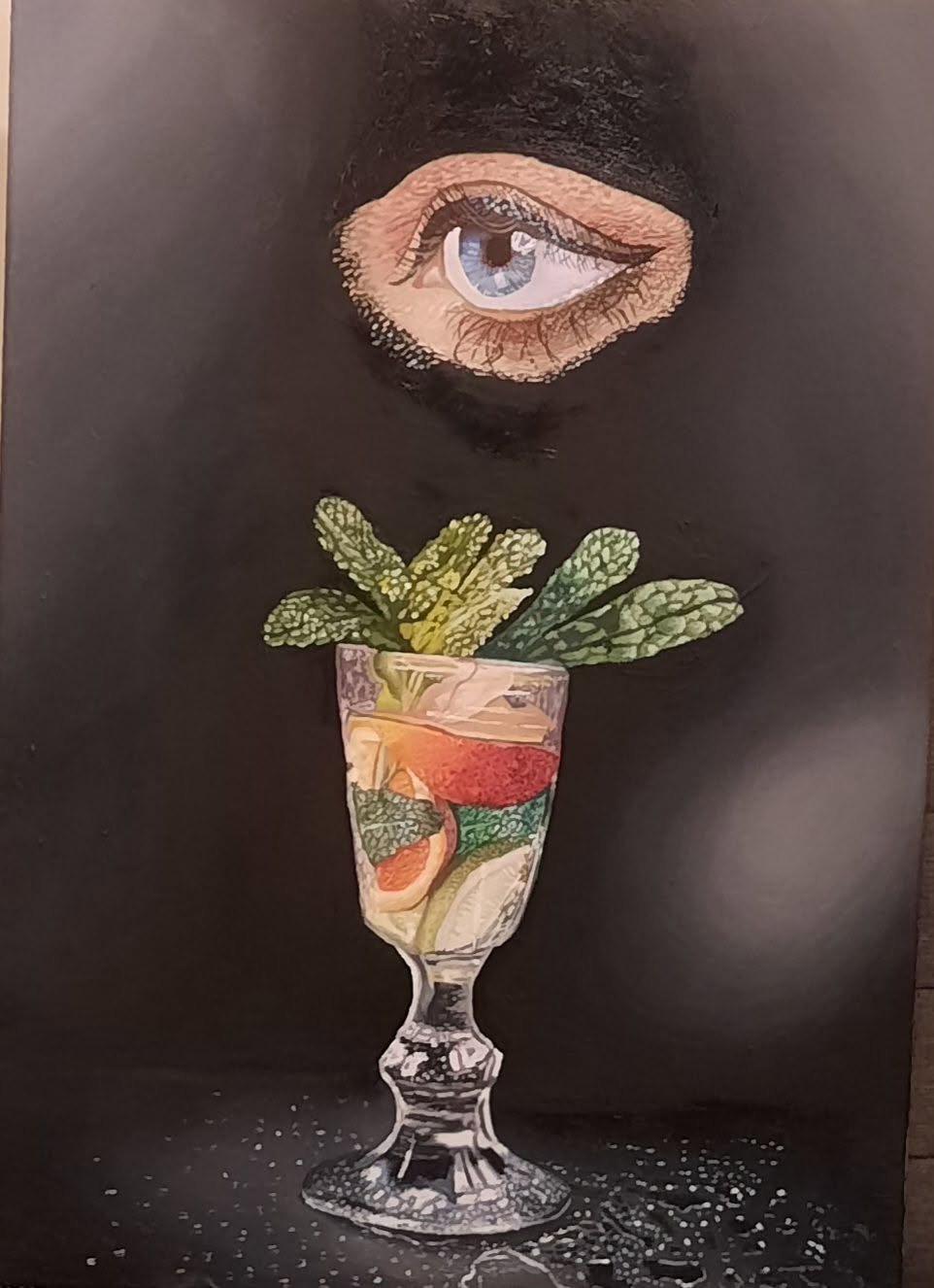
Elsewhere, Day’s work leans into juxtaposition and, at times, a dry sense of humour. Beauty Is in the Eye of the Beholder places an eye alongside a glass of fruit cocktail, a pairing that owes a clear debt to Day’s longstanding admiration for Salvador Dalí, particularly Dalí’s contribution to the dream sequence in Alfred Hitchcock’s Spellbound. The painting is not a retelling of that sequence but a response to its logic, using two unrelated objects to argue, gently, that beauty can appear in more than one form. It is a good example of how Day’s surrealism tends to work: not through spectacle, but through quiet, considered oddity.
Landscape, Science and Symbol
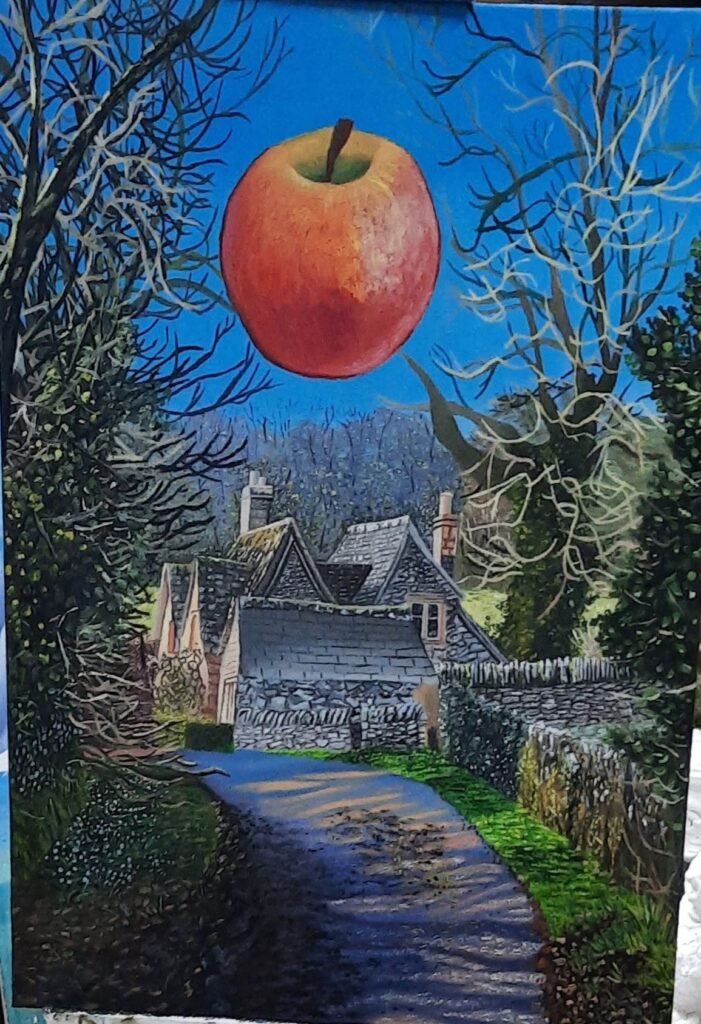
Gravity, from 2025, is a more ambitious statement of the same instincts. An apple floats into the sky above an English countryside reminiscent of the landscape Isaac Newton knew, fusing scientific history with surrealist imagery. Day has described a personal connection to the painting as an artist with autism, pointing to figures like Newton as sources of inspiration and evidence that unconventional thinking has long produced valuable ideas. He frames this as his own perspective rather than a settled historical fact, and the painting benefits from that restraint, functioning as a meditation on imagination and inheritance rather than a claim about Newton’s life. The image of an apple defying gravity above a landscape tied to the discovery of gravity itself gives the painting a neat, understated symmetry between nature, science and surrealist invention.
From Canvas to Constructed Scene
The move into sculpture and dioramas since 2020 extends this same interest in symbolic arrangement into physical space. Where painting allows Day to juxtapose objects within a frame, diorama making lets him build entire environments, complete with their own internal logic and scale. It is a natural expansion for an artist whose two-dimensional work has always suggested more world than the canvas could hold.
Where the Practice Is Heading
That expansion is currently taking a playful turn with a new series of dioramas depicting zombies on holiday, a project that continues Day’s long-running interest in placing the familiar next to the strange. Holiday imagery, ordinarily associated with rest and leisure, becomes something else entirely once zombies are involved, and the humour sits comfortably alongside the more contemplative work that precedes it. Across painting, photography, sculpture and now diorama making, James Day’s practice keeps circling the same core idea: that meaning often lives in the space between two things that should not, by rights, belong together.
Step into the space between the ordinary and the absurd. Discover James Day’s latest dioramas, surrealist paintings, and ongoing experiments on Instagram at @thequirkypainter5.
