

Oenone Hammersley is an internationally recognized mixed-media artist whose vibrant paintings explore the beauty, complexity, and fragility of the natural world. Through bold colour, expressive texture, luminous surfaces, and abstract forms, she creates artworks that invite viewers to look more closely at the world around them. Her nature-inspired paintings, particularly her depictions of water and tropical landscapes, combine visual energy with a deeper awareness of the environmental challenges facing the planet.
Born in England in 1957 and now based in Florida, USA, Hammersley has developed an artistic language shaped by both her creative background and her extensive travels. Her experiences across Southeast Asia, India, Africa, and Latin America have exposed her to diverse landscapes, cultures, colours, and organic forms. These influences continue to appear throughout her work, where recognizable elements of nature are transformed into imaginative abstract compositions.
A Creative Vision Shaped by Nature and Travel
Hammersley’s artistic approach is strongly connected to her fascination with the natural environment. Her travels have provided an extensive visual vocabulary from which she draws, allowing her to reinterpret landscapes rather than simply reproduce them. Tropical vegetation, flowing water, forests, and other elements of the wilderness become starting points for compositions filled with movement and colour.
Her earlier experience in theatre design has also contributed to her distinctive visual approach. Theatre requires an understanding of colour, light, composition, atmosphere, and visual storytelling, and these qualities are evident in Hammersley’s paintings. Rather than treating the canvas as a static surface, she builds compositions that seem to unfold across it, using layers, patterns, and contrasts to create a sense of movement.
This combination of theatrical sensibility and environmental inspiration enables Hammersley to move between representation and abstraction. Her paintings can suggest recognizable landscapes while simultaneously encouraging viewers to interpret the forms through their own imagination.
Colour, Light, and the Language of Abstraction
Colour is central to Hammersley’s artistic vocabulary. Her compositions often feature intense turquoise, cobalt, lime, pink, yellow, and other vivid tones that interact across the surface. Light further enhances these colours, creating paintings with a sense of luminosity and depth.
Her artist statement describes colour and light as ways of emphasizing the vanishing wilderness and encouraging people to notice and appreciate the rare, raw beauty of the world around them. At the same time, her abstract compositions reflect an unsettled relationship between humanity and nature, suggesting the ways in which human activity continues to alter the environment.
This balance between beauty and concern is an important characteristic of Hammersley’s work. Her paintings are visually captivating, but their appeal is not purely decorative. Beneath the energetic colours and complex forms is a sustained interest in ecological responsibility.
“Tropical Landscape with Palm Tree”
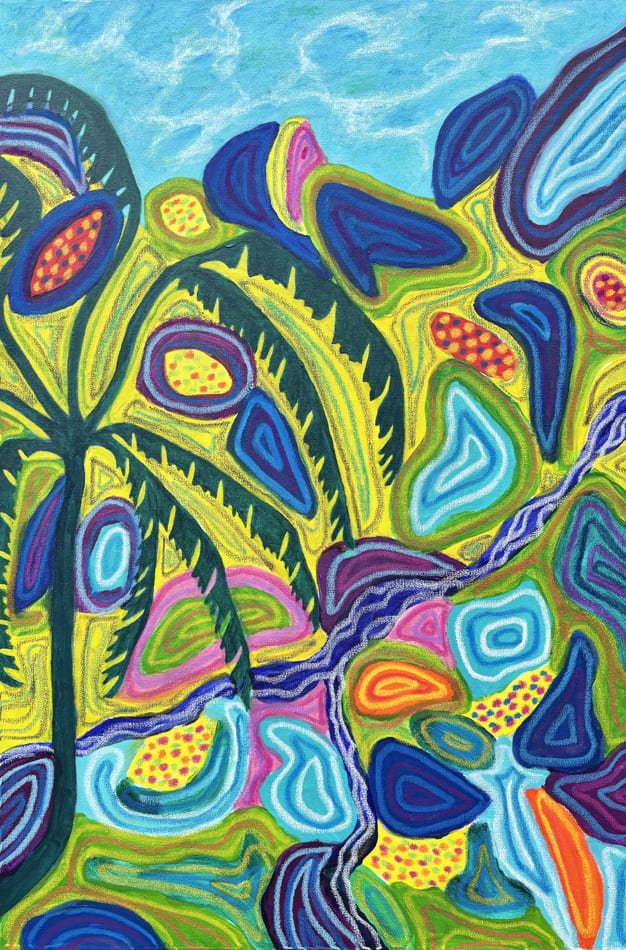
One example of Hammersley’s ability to transform the natural world into expressive abstraction is her mixed-media painting Tropical Landscape with Palm Tree. Measuring 30 by 20 inches, the work combines acrylic and oil pastel on canvas to create a vivid interpretation of a tropical environment.
The painting presents a lively arrangement of organic forms and layered contours in turquoise, cobalt, lime, pink, and golden yellow. Instead of presenting a tropical landscape through conventional perspective, Hammersley breaks its visual components into rounded shapes, winding patterns, and rhythmic structures.
The composition creates a feeling of movement across the canvas. Organic forms appear to overlap and interact, while dotted concentric details introduce smaller points of visual interest. The textured surface adds another dimension to the work, encouraging the viewer to move between the broader composition and its intricate details.
The result is an artwork that feels simultaneously familiar and imaginative. The palm tree and tropical setting provide a recognizable connection to nature, while the abstraction allows the landscape to become something more expansive. Each viewing can reveal different relationships between the shapes, colours, and patterns.
A Materially Rich Artistic Process
Hammersley’s distinctive appearance is also the result of an experimental mixed-media process. Her practice incorporates large-scale oil paintings, collage, acrylic, and oil pastels, alongside a technique that combines hand-painting with multiple paint pours and glossy resin finishes.
This layering process gives her paintings considerable surface complexity. Rather than relying solely on brushwork, she allows materials to interact with one another, creating variations in texture, transparency, depth, and reflection.
The combination of controlled painting and more fluid techniques is particularly appropriate to her subject matter. Natural environments are rarely made up of perfectly ordered forms. Water flows, vegetation overlaps, light changes, and landscapes contain countless subtle variations. Hammersley’s process mirrors some of this organic unpredictability while maintaining a strong sense of artistic composition.
Art as a Voice for Conservation
Environmental protection is not separate from Hammersley’s artistic practice. It is one of the central motivations behind her work. Her paintings address concerns including deforestation, ocean pollution, overfishing, water scarcity, and the poor management of water resources.
Her water paintings have been particularly influenced by concerns about the unequal availability of water around the world and the pollution affecting oceans and waterways. Through these works, she seeks to communicate the importance of water as a fundamental part of human existence and the wider natural ecosystem.
A collection of her water paintings has been dedicated to Ocean Conservancy, reflecting her commitment to using art to draw attention to environmental issues. Her support for conservation organizations extends beyond her paintings, with donations benefiting organizations involved in protecting wildlife, forests, oceans, and threatened habitats.
Past exhibitions of her work have benefited organizations including the World Land Trust, Fauna and Flora International, Friends of the Earth, the World Wildlife Fund, Pandrillus, the Wildlife Protection Society of India, turtle conservation efforts in Greece, and Earthwatch.
An International Exhibition History
Hammersley’s work has been exhibited across major artistic centres and at galleries and art fairs in the United States and Europe. Her exhibition history includes presentations in Washington DC, New York, London, Miami, Los Angeles, Alexandria, and other locations.
Among her notable exhibitions are Magnificent Trees at The Arts Club of Washington DC, water painting exhibitions at Saphira and Ventura Gallery in New York and Walter Wickiser Gallery in New York, and presentations at Watergate Gallery and Patrick’s Gallery in Washington DC.
Her work has also appeared at major art fairs, including the LA Art Show, Art on Paper in New York, Art Wynwood in Miami, the Seattle Art Fair, Art Miami, and Palm Beach Modern and Contemporary. Her participation in these exhibitions has introduced her paintings to audiences across different regions and strengthened her presence within the international contemporary art scene.
Her exhibition history demonstrates the breadth of her practice, from water-focused paintings to works exploring trees, fire, wind, and broader interpretations of the natural environment.
Recognition and Collections
The significance of Hammersley’s artistic career is also reflected in the collections that have acquired her work. Her paintings are held in private and public collections internationally, including the Shell Museum on Crete and the private collection of the Guggenheim families.
Her work has also entered the collection of H.R.H. Princess Fatima Bint Mubarak of the U.A.E., further reflecting the international reach of her artistic practice.
For collectors, Hammersley’s paintings offer a combination of visual impact and meaningful subject matter. Her ability to translate ecological concerns into vibrant, contemporary compositions gives the work an enduring relevance while allowing each painting to maintain its own distinctive visual identity.
Celebrating the Beauty of a Changing World
Oenone Hammersley’s paintings exist at the intersection of beauty, abstraction, and environmental awareness. Her vivid colours and layered surfaces celebrate the richness of the natural world, while her subject matter encourages viewers to consider what may be lost if that world is not protected.
Tropical Landscape with Palm Tree exemplifies this approach. Through its energetic colours, organic shapes, winding contours, and richly textured surface, the painting transforms a familiar tropical setting into an imaginative abstract experience. It demonstrates Hammersley’s ability to take inspiration from the real world and reconstruct it through her own visual language.
Her work ultimately asks viewers to pause and look more carefully at nature. The forests, oceans, waterways, and landscapes that inspire her paintings are presented not simply as subjects of beauty, but as precious environments deserving attention and protection. In this way, Hammersley’s art becomes both a celebration of the planet and a reminder of humanity’s responsibility toward it.
