

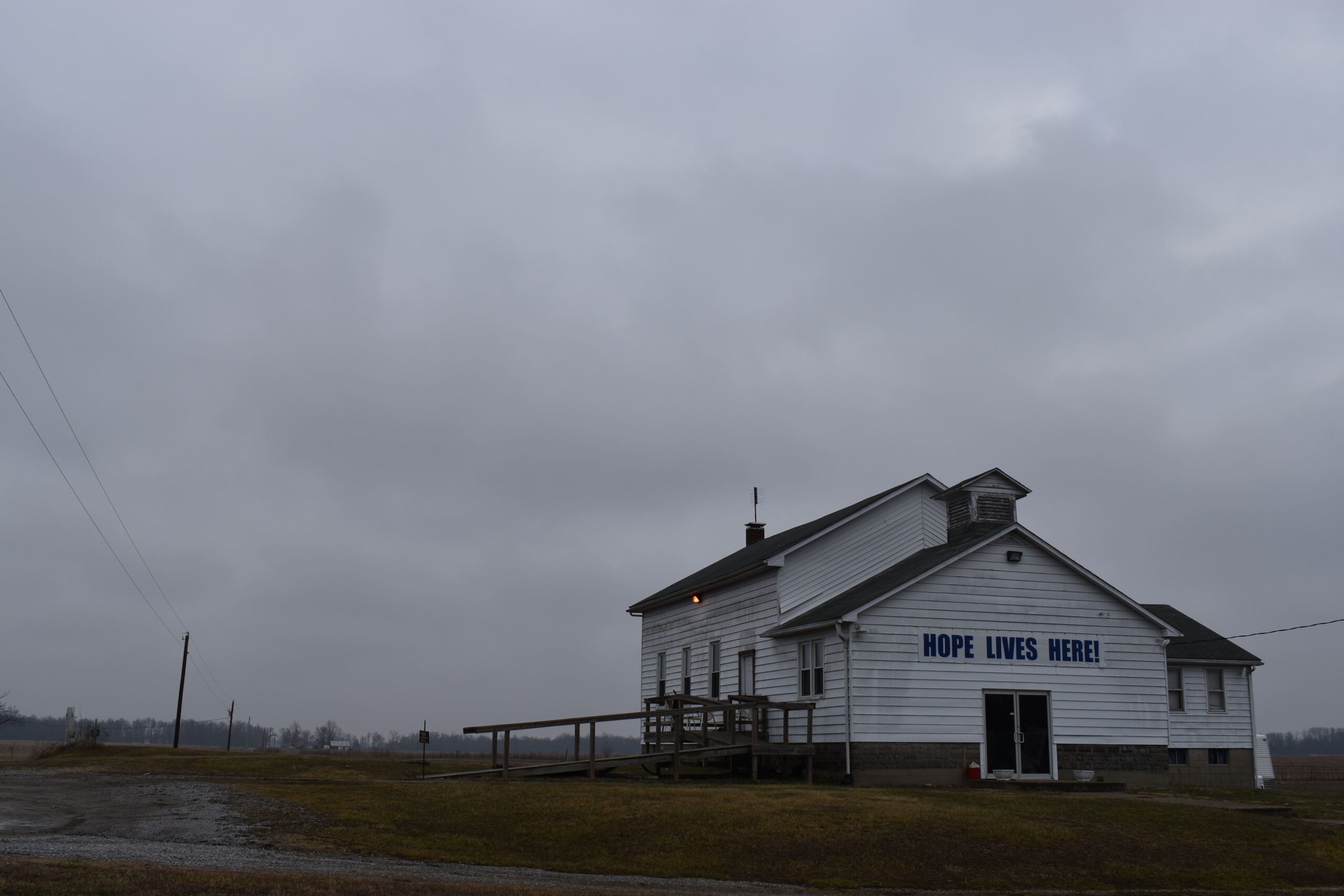
Michael Aldag has spent his career looking at Southern Illinois the way most people only look at places they’re about to leave: closely, and with a kind of ache. Born and raised in the region, Aldag has built a body of work that returns again and again to the Midwest landscape, rendered in tones so somber they feel less like a photographic choice and more like an honest report on how the land actually looks. His newest and most focused project, a series called Temple, takes that sensibility and points it at something specific: the empty shells of buildings that used to be churches.
A Landscape of Absence
Southern Illinois is not a region that gets much attention in the broader art world, and that is, in part, the point of Aldag’s work. He photographs what is actually there: fields, small towns, the quiet architecture of communities that have shrunk or shifted or simply changed shape over the decades. His images don’t romanticize the Midwest, nor do they flatten it into nostalgia. Instead, they hold a kind of stillness, the visual equivalent of a long pause before someone says something they’ve been thinking about for a while.
That stillness is what makes Temple feel like a natural extension of everything Aldag has done before, even as it narrows his focus considerably. The series turns his camera toward former church buildings scattered across his home region, structures that once anchored congregations and now stand empty, repurposed, or simply forgotten. Aldag doesn’t editorialize in the traditional sense. He photographs the buildings as they are. But the titles he gives these images do a quiet kind of work, nudging viewers toward questions that go beyond the physical structure in the frame.
What a Church Becomes When It’s No Longer a Church
There is something particular about a church building that has outlived its congregation. Unlike an abandoned house or a shuttered storefront, a former church carries a specific kind of weight: it was built to hold something larger than the people inside it, and now it holds nothing at all, or something else entirely. Aldag’s photographs sit inside that tension without resolving it. They don’t tell viewers what to feel about faith, or community, or the slow demographic changes that have hollowed out small towns across the Midwest and much of rural America. They simply present the buildings, and let the questions follow.
That restraint is part of what gives Temple its power. A photograph of an abandoned church can become a symbol for almost anything: the decline of organized religion, the economics of rural depopulation, the way memory clings to physical space long after the people who made those memories have moved on or passed away. Aldag’s work doesn’t insist on any single reading. It offers the structure, weathered and specific, and trusts the viewer to sit with what it might mean.
Quiet Bell: A Closer Look
Among the photographs in the Temple series, Quiet Bell (2025) stands out, both for what it depicts and for the recognition it has received. The image is a 16 by 24 inch metal print showing what was once the home of Bell Missionary Baptist Church in rural Iuka, Illinois. Like a number of former church buildings across Southern Illinois and elsewhere in the country, the structure has since been abandoned.
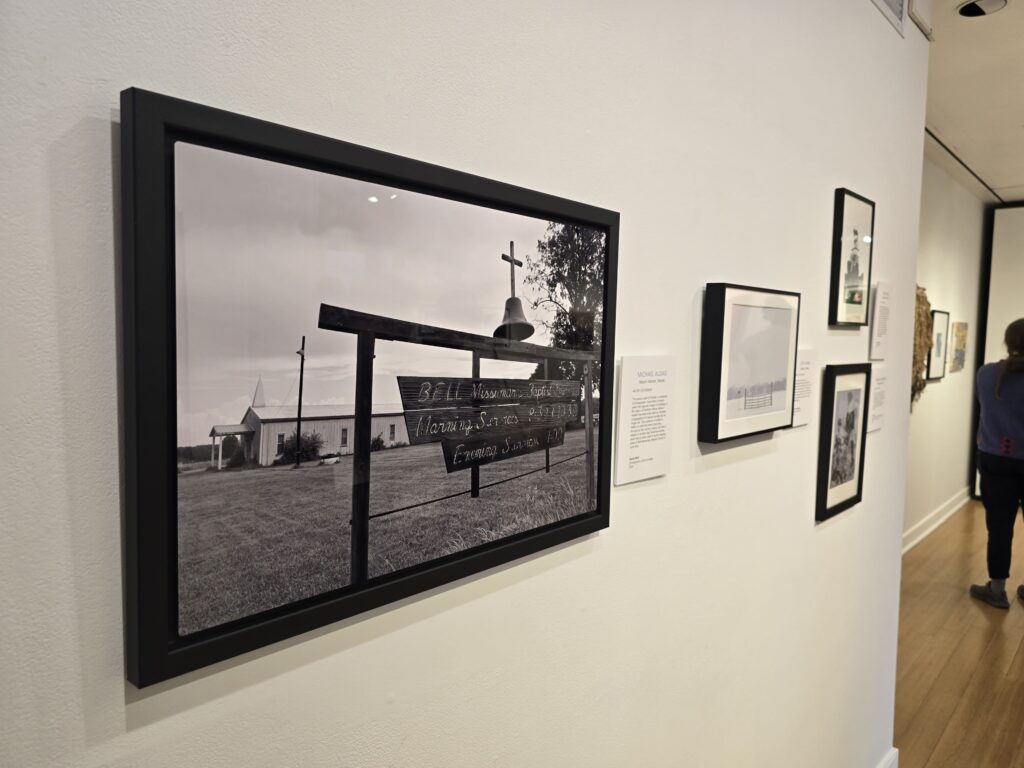
The title itself does quite a bit of work. A “quiet bell” suggests an instrument built for sound, for calling people together, that has gone silent. It’s a small phrase, but it reframes the image: this isn’t just a picture of a building falling into disrepair, it’s a picture of a specific kind of silence, one that used to be filled with something. Whether that silence reads as loss, as simple change, or as something more neutral is left largely to the viewer, which is consistent with how Aldag approaches the rest of the series.
Quiet Bell was selected for the 2026 Illinois All-State Art Exhibition at the Giertz Gallery in Champaign, Illinois, a recognition that places the work, and by extension the Temple series, in front of a wider audience than a regional photograph of a rural building might otherwise reach. It’s a meaningful marker for a project that is, at its core, about looking closely at places most people drive past without a second glance.
The Object Itself
One detail that distinguishes Aldag’s practice is his commitment to the printed photograph as a singular object. He does not produce multiples of the same image. Each print exists once, and once only, which changes the relationship between the photograph and the person looking at it. It is no longer simply documentation of a moment; it becomes its own physical artifact, as unrepeatable in its way as the building it depicts.
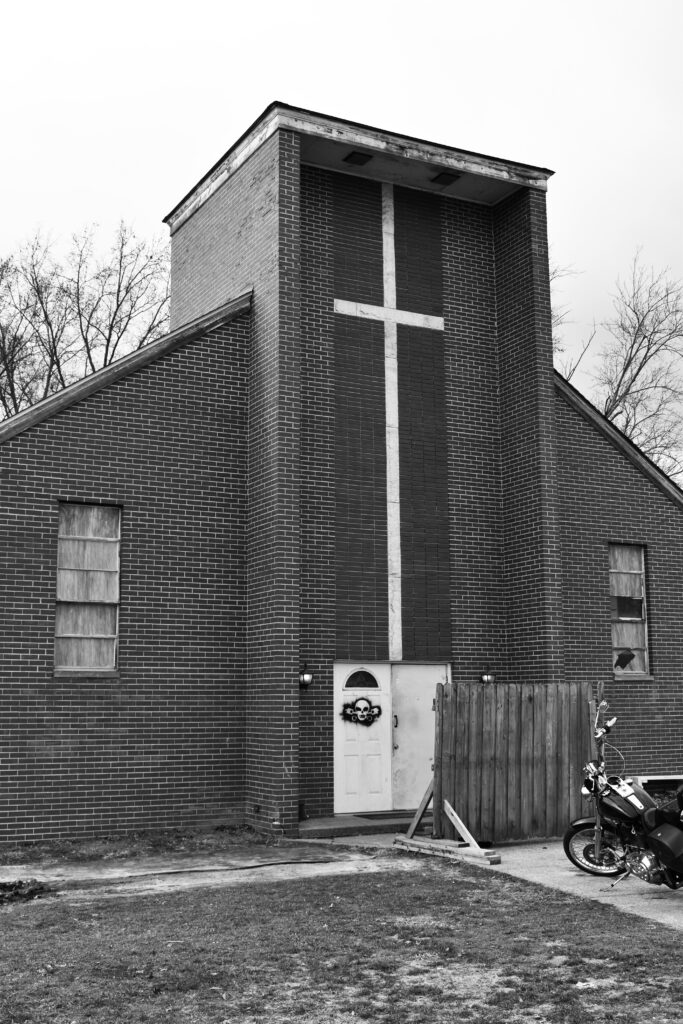
That commitment extends to material as well. Aldag presents his photographs across a range of surfaces, paper, metal, fabric, and glass among them, and each material changes how the image reads. A metal print like Quiet Bell has a different weight and sheen than a fabric or paper presentation might, altering the texture of the abandoned church it depicts and, with it, the mood the viewer takes away. The choice of material isn’t incidental. It’s part of how each Temple photograph makes its case.
Aldag’s work has appeared in juried exhibitions across Illinois, Arizona, and Ohio, as well as in international online competitions, building a track record that has run alongside the development of the Temple series itself. His photographs can be purchased through the Illinois State Museum in Springfield, Illinois, connecting the work to an institution invested in preserving and presenting the state’s cultural history, a fitting home for images so concerned with what gets preserved and what gets left behind.
What Remains
Temple is, in the end, a series about disappearance, but not only disappearance. It’s about what a place holds onto even after its original purpose has gone: the outline of a doorway, the shape of a steeple against the sky, the memory embedded in a structure that no longer serves the community it was built for. Michael Aldag doesn’t offer easy answers about what these emptied churches mean for faith or community or the towns that surround them. He offers the buildings themselves, patiently observed, and asks viewers to bring their own questions to the frame. In a region defined as much by what has left as by what remains, that may be the most honest gesture a photographer can make.
Where to See and Purchase the Work
Michael Aldag’s photographs, including pieces from the Temple series, can be purchased through the Illinois State Museum Shop in Springfield, Illinois. More of his work can be found on his website and Facebook page.
Website: https://michaelaldag.carbonmade.com/ Facebook: https://www.facebook.com/MichaelAldagFineArtist Illinois State Museum Shop: https://shop.illinoisstatemuseum.org/
