

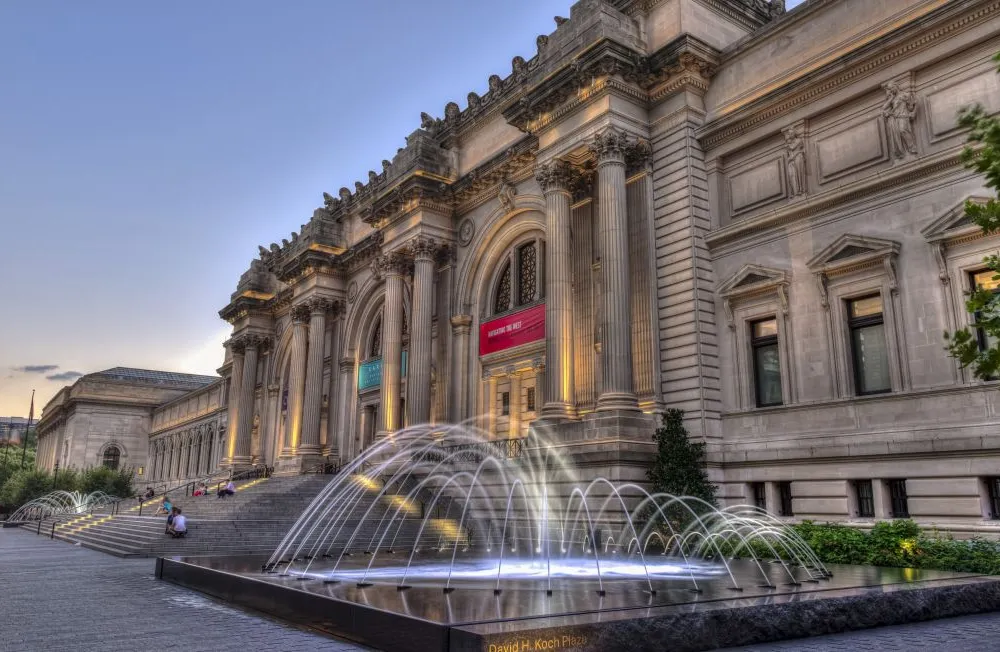
The Metropolitan Museum of Art‘s Costume Institute is putting form back into fashion and placing fashion at the forefront of New York’s busiest institution.
On Monday, the museum revealed that its spring 2026 blockbuster fashion exhibition will be “Costume Art,” which examines the bond between the dressed body and visual art history. Andrew Bolton, the curator in charge of the Costume Institute, said that that relationship had long been downplayed in the belief that disembodying fashion would elevate it to “art” status.
The Met is putting not only its curatorial weight but its money behind this correction: The exhibition will inaugurate the nearly 12,000-square-foot Condé M. Nast galleries adjacent to the Great Hall, which bears the name of the late magazine magnate in recognition of his company’s lead gift.
The exhibition will acknowledge “the centrality of the dressed body” in the Met’s collection by juxtaposing historical and contemporary garments from the Costume Institute with paintings, drawings, and objects spanning 5,000 years and drawn from the 16 other curatorial departments. “There’s not a single gallery in the museum in which the dressed body is not represented, making fashion the connecting thread across the 600,000 squarefeet of galleries in the museum.”
The debate over whether fashion is art is a perennial one, despite the tremendous tourist draw the Costume Institute’s has proven to be, as well as the wealth of criticism that accompanies its marquee exhibition. “Heavenly Bodies: Fashion and the Catholic Imagination,” the most-visited exhibition in the museum’s history, drew 1.66 million visitors, surpassing even “Treasures of Tutankhamun” in 1978, a show of such mythic scale it redefined the notion of a modern museum blockbuster.

“Over the last two decades, fashion has increasingly gained acceptance as a subject worthy of the same serious contemplation as that accorded the traditional arts painting and sculpture,” Bolton said. “Fashion’s acceptance as an art form, however, has occurred very much on art’s terms, being premised on its renunciation of all connections with the body. What’s been overlooked is how these garments are experienced by their wearers, not just as visual artifacts to be looked at, but as material garments to be worn and lived in.”
Bolton has organized the show around a “typology of bodies” that can be loosely categorized into three categories, including the sinewy nudes ubiquitous in classical art, as well as bodies rarely celebrated in fashion, such as the pregnant or aging. The preview offered a glimpse of the sort of pairings visitors can expect: British designer Georgina Godley’s 1986–87 “pregnancy dress,” fitted on a mannequin with a swollen belly, displayed alongside a photograph by Harry Callahan, double-exposed so his wife’s baby bump emerges like a planet from the shadow of space, with two moon like breasts orbiting nearby. Bolton, it’s worth noting, said in the press preview that the majority of work shown would be in dialouge from Western art history.
Each designer here has accentuated or uncannied human nature, whether by drawing on art allegory, anatomical imagery or both. A fitted 2009 jumpsuit by Walter Van Beirendonck from 2009 is adorned with the nude male form, evoking a retelling of the Garden of Eden, in which Adam eats the apple and, in a plausible twist, feels no shame for his newfound nakedness.

“Costume art is a celebration of the body in all of its strengths and weaknesses, its resiliencies and vulnerabilities, its perfections and perfections, its idiosyncrasies and commonalities, its sublime beauty, its wondrous complexity, its glorious and miraculous diversity,” Bolton said.
